
The Indian economy is likely to witness close to double-digit growth in the current fiscal year despite the second COVID-19 wave ravaging the country, Principal Economic Adviser (PEA) Sanjeev Sanyal said on Wednesday. The economy is slowly getting back to normalcy as the number of COVID-19 cases is declining, he said while participating in India Global Forum event. "We are probably going to see close to double-digit, if not double-digit (growth) in this financial year," he said.

'After that the burdens of an ageing population will be upon us, and the share of working age population will shrink.'

From the 30-share blue-chip pack, Adani Ports, UltraTech Cement, Larsen & Toubro, Sun Pharma, HDFC Bank, ICICI Bank, NTPC and State Bank of India were the major laggards. Tata Consultancy Services, Reliance Industries, ITC, Asian Paints, HCL Tech and Maruti were among the gainers.

Foreign investment firm Credit Suisse First Boston said on Thursday that delayed monsoon is unlikely to have a "significant impact" on India's economic growth pegged at 5.7 per cent in 2004-05.

NCAER said the monetary policy measures are unlikely to revive growth at this juncture and suggested providing fiscal stimulus, which too can be challenging unless it can be financed through better revenue generation.

India's economy is projected to maintain growth above 7 per cent in 2026-27 (FY27), supported by strong domestic consumption and investment, even as global growth faces risks from geopolitical tensions, according to industry body Assocham.
The government on Friday said the economy may have expanded by 4.5 per cent in 2012-13, compared with the earlier estimate of 5 per cent, on account of subdued performance in agriculture, mining and manufacturing.

Optimism comes at a time when several agencies trimmed forecast to as low as 5.5% citing inaction policy paralysis as major growth impediment

The country's real GDP growth in the first quarter will be better than the Reserve Bank's estimate of 8 per cent, economists said on Tuesday. Economists at the country's largest lender SBI pegged the growth at 8.3 per cent while domestic rating agency Icra estimated it to come even higher at 8.5 per cent. The Reserve Bank of India (RBI), which expects the GDP to grow at 6.5 per cent in FY24, has estimated a growth of 8 per cent in the April-June period.
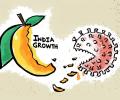
The Reserve Bank on Wednesday retained the GDP growth forecast at 9.5 per cent for the current fiscal but cautioned that the economic recovery is not yet strong enough to be self-sustaining and durable.
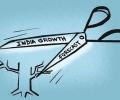
The International Monetary Fund (IMF), in its latest World Economic Outlook report, has slashed its forecast for India's FY23 gross domestic product growth to 8.2 per cent from 9 per cent, saying that higher commodity prices will weigh on private consumption and investment. This was one of the steepest cuts for emerging economies compared to the IMF's January WEO forecasts. Saying that global economic prospects have worsened significantly due to commodity price volatility and disruption of supply chains caused by the war in Europe, IMF cut its global growth outlook for calendar year 2022 to 3.6 per cent from 4.4 per cent, and said both Russia and Ukraine could experience large GDP contractions.

The Reserve Bank of India (RBI) is widely expected to keep its benchmark repo rate unchanged in the August monetary policy review, with economists citing elevated inflation risks and the pending closure of the FCNR(B) deposit scheme as key factors. Most anticipate a 'Neutral' policy stance but with a hawkish tone due to geopolitical tensions, high crude oil prices, and an uneven monsoon.
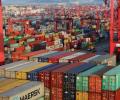
India's trade deficit reached a six-month high of $31.98 billion in July, driven by a sharp increase in imports, particularly crude oil, electronic goods, coal, and fertilisers. Both merchandise exports and imports recorded their second-highest levels during the same period.

The Indian economy is expected to grow around 10 per cent during the current financial year on the likelihood of fewer COVID-19-linked supply disruptions and buoyancy in the global economy, said Poonam Gupta, director general of economic think-tank NCAER. The real challenge, however, would be to sustain a growth rate of 7-8 per cent in years to come, she said. "We could see annual growth in the ballpark range of about 10 per cent. "The reasons for this perceived optimism are: fewer supply disruptions; increased pent-up demand in the traditional and contact-intensive services; and a buoyant global economy.
A ramp-up in COVID-19 vaccination, healthy advance estimates of kharif (summer) crop and faster government spending were the factors which led to the revision, the agency said in a statement. It can be noted that after the 7.3 per cent contraction in 2020-21, there were expectations of a higher growth number in 2021-22.

A look at six indicators shows all of them have collapsed from positive growth in April to contraction in September.

India's GDP growth to reach 8% by 2017. says World Bank

The Reserve Bank of India (RBI) maintained its key policy rates for the fourth consecutive time, keeping the repo rate at 5.25 per cent, while the benchmark BSE Sensex closed 152 points higher in a volatile session, recovering from an intraday dip.

Arundhati Bhattacharya, Salesforce President and CEO for South Asia, stated that cloud and AI are democratising capabilities, offering India a unique opportunity to leapfrog in technology. Speaking at the IMC Chamber of Commerce, she emphasised that AI will create more jobs and urged Indian businesses to transform using technology, rather than merely digitising. She also highlighted the significant economic potential of AI adoption for India.
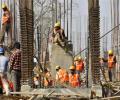
The First Advance Estimates of National Income, 2016-17 did not reflect the impact of demonetisation, effected on November 9 and are based on sectoral data for only seven months to October.

NSO has pegged economic growth at 5 per cent in 2019-20 in its second advance estimates.

The Indian stock market mythos of 36 years is wrapped in a diaphanous negligee, lashed together by a delicate, etheric sash of 1.6 bull markets. To make money from here on will require a ground invasion, trench by trench, rather than carpet bombing. Way more difficult, points out Shankar Sharma.

India's exports of printed circuit boards (PCBs) to China dramatically increased over 40-fold to $1.5 billion in FY26, indicating a significant shift where China is increasingly importing simpler electronic assemblies from India as it focuses on higher-value manufacturing domestically.

S Mahendra Dev, chairman of the Economic Advisory Council to the Prime Minister, expressed confidence that the rupee would stabilise around the 92-93 level against the US dollar, despite geopolitical tensions, and that foreign investment flows would return.
Powered by a 9.2 per cent growth in the manufacturing sector, India's economic growth stood at 6.9 per cent for 2004-05 fiscal compared to 8.5 per cent during the previous financial year.
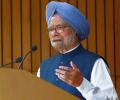
He said the 'toxic combination of deep distrust, pervasive fear and a sense of hopelessness in our society' is stifling economic activity and growth.

The overall breadth was positive as 1,593 stocks advanced while 1,295 stocks declined.

RBI Governor Shaktikanta Das said that early containment of the pandemic could impart an "upside" to the economic growth outlook.
India's projected 8.1 per cent GDP growth rate this year was "quite achievable" as investors' confidence had gone up substantially due to sustained economic reforms, a noted economist said on Monday.
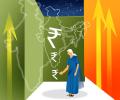
The World Bank has affirmed India's strong position to withstand the current global energy shock, citing high foreign exchange reserves, fiscal space, and low inflation as key buffers supporting continued growth despite international headwinds.

Chief Economic Advisor Krishnamurthy Subramanian said India's economy will witness a decline in the current fiscal, but the drop will be limited if there is an economic recovery in the October-March period.

The country has been clocking a sub-5 per cent growth for the past two financial years, mainly on account of slowdown in investments.

A working paper by the Economic Advisory Council to the Prime Minister (EAC-PM) reveals a continuous decline in the rate at which foreign-owned firms invest in fixed assets in India since the FY20 peak, contrasting with a steady increase from Indian business groups.

The previous high in quarterly GDP growth was recorded in the January-March quarter of 2015-16 at 9.3 per cent.

The successful hosting of the 18th BRICS summit in New Delhi has provided a significant boost to the BJP, offering a timely opportunity to strengthen its narrative against the opposition ahead of crucial assembly elections next year. BJP sources highlight the BRICS grouping's strong condemnation of the Pahalgam terror attack and the consensus declaration as major diplomatic victories for the Modi government, countering criticisms of its foreign policy. The party plans to leverage these outcomes during its month-long Seva Sankalp campaign to connect with various sections of society.

The BRICS summit in New Delhi brings together leaders from major emerging economies to address global challenges like trade disputes, geopolitical upheavals, and the economic impact of conflicts in Ukraine and West Asia. India, as chair, aims to position BRICS as an economic growth engine, focusing on the Global South's food, energy, and supply chain security. The summit also highlights the grouping's expansion and its growing influence in global governance.

This is lower than the country's growth rate of 6.7 per cent for the financial year 2008-09.

Prime Minister Narendra Modi cautioned against the 'weaponisation' of technology and critical minerals at the BRICS summit, advocating for cooperation to foster shared prosperity. Concurrently, Chinese President Xi Jinping announced plans for an open-source AI ecosystem for BRICS nations, positioning Beijing as a key technology partner amid global AI competition.
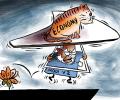
India's growth outlook has weakened sharply this year, with a crunch that started with the non-banking finance institutions spreading to retail businesses, car-makers, home sales and heavy industries.
